
Educator Resources
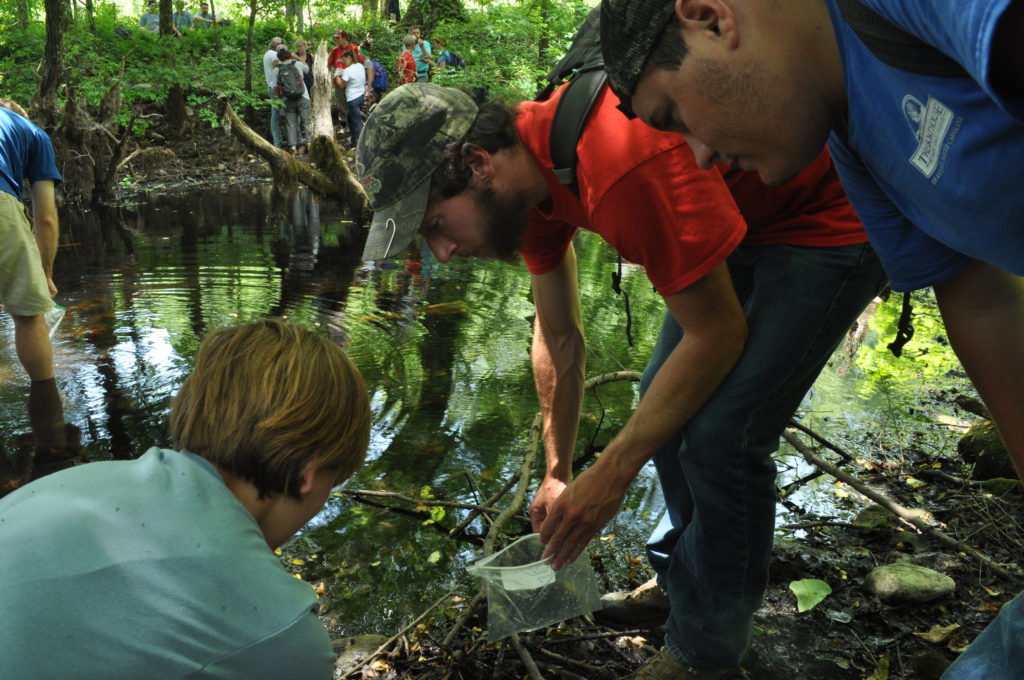
Great Smoky Mountains Institute at Tremont believes that to help feel comfortable, capable, and confident in taking students outside, teachers benefit from having access to resources, tips, ideas, etc. On this page, you will find helpful resources from Tremont Institute and partner organizations to add to your teaching toolkit. Taking your students outside can feel daunting, and sometimes impossible, but with the right routines, patience, and practice, you and your students can have transformative experiences in the natural world, just outside your classroom door!
 Lesson plans created by Tremont Institute are tied to Tennessee Academic Standards for Science and the 3 Dimensions of Learning, English Language Arts Academic Standards, Mathematics Academic Standards, Social Studies Academic Standards, and Social and Emotional Learning Standards.
Below are links to curricula designed to provide teachers much-needed resources for working with new standards, as well as to help make student learning more local, personal, and relevant.
Asking Questions & Defining Problems: Create-A-Critter
Using Mathematics & Computational Thinking : Mean, Median, Mode
Obtaining, Evaluating, & Communicating Information: Mini Hike
Constructing Explanations & Designing Solutions : Schoolyard Mapping
Asking Questions & Defining Problems: Sound Mapping
Planning & Carrying Out Investigations: Color Exploration
Great Smoky Mountains Institute at Tremont educational approach is informed by curriculum from BEETLES (Better Environmental Education, Teaching, Learning & Expertise Sharing). BEETLES, a program out of the Lawrence Hall of Science of the University of California Berkeley, is passionate about improving the quality of outdoor education for residential and schoolyard teaching. All BEETLES resources consider the past 50 years of student-centered learning, teacher research and ideas on what motivates people to learn. They believe that people learn outdoor based science best when they; “engage directly with nature, experience instruction based on how people learn, think like a scientist, participate in culturally relevant learning environments, and learn through discussion.”
Great Smoky Mountains Institute at Tremont was invited to participate in an Educational Leadership Institute that helped us incorporate effective teaching practices into professional learning experiences for our staff and educator workshops. The Institute helped to strengthen Tremont’s curriculum by expanding our tools and approaches that we use with our schools. BEETLES resources support brain-based learning and the Next Generation Science Standards (NGSS) to make learning more impactful.
Discussion Routines: Walk & Talk
Making Observations: I notice, I wonder, It reminds me of
Embedded Assessment: Mind Pie
Reflective Journaling: Field Journaling with Students
Student-Centered Investigation: Exploratory Investigation
Questioning Strategies: Questioning Strategies
Green Schoolyards America is a national organization that supports the green schoolyards movement by empowering schools and communities to strengthen their environment through green spaces. They conduct research which tracks student, ecological, and community health and well-being to advocate for policies that assist in making the schoolyard and community a more biodiverse environment for learning and play, and create free activity guides each year to encourage schools to get out into their schoolyard for education and play.
International School Grounds Month Activity Guide (2018 Edition)
Living Schoolyards Activity Guide (2018 Edition)
“First, I just want to say the culture of my classroom has totally changed. By coming to Tremont and learning how to start open-ended questions, and learning myself, that it is okay for students to have the wrong answer and work through that productive struggle, I have had a breakthrough in my career.”– Meghan Nicely, New Hopewell Elementary School Teacher
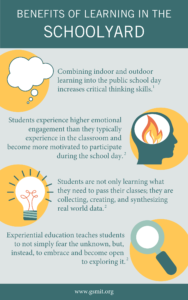
ٰ¹Ernst, J & Monroe, M. (2004). The effects of environment-based education on students’ critical thinking skills and disposition toward critical thinking. Environmental Education Research, 10(4), 507-22.
²James, J. K & Williams, T. (2016). School-Based Experiential Outdoor Education: A Neglected Necessity. Journal of Experiential Education, 40(1), 58-71.
Schools around the country are beginning to recognize the critical importance of Social and Emotional Learning (SEL) to their students’ overall success in school. The Collaborative Academic, Social and Emotional Learning (CASEL) has created a toolkit to be used by administrations and teachers to gain a better understanding of what social and emotional learning is and how it can be incorporated into the school day. CASEL reports that successful SEL should not be an add-on to the school day, but rather, it should be woven into what teachers are already doing in class.
According to CASEL, “social and emotional learning is the process of developing students’ and adults’ social and emotional competencies—the knowledge, skills, attitudes, and behaviors that individuals need to make successful choices”³. SEL builds on an individual’s social and emotional competencies, giving them a foundation on which to build towards success in academics, sports, and overall well-being. These competencies, according to CASEL are; self-awareness, self-management, social awareness, relationship management, and responsible decision-making. These competencies address skills that students need to become successful in school and their future careers.
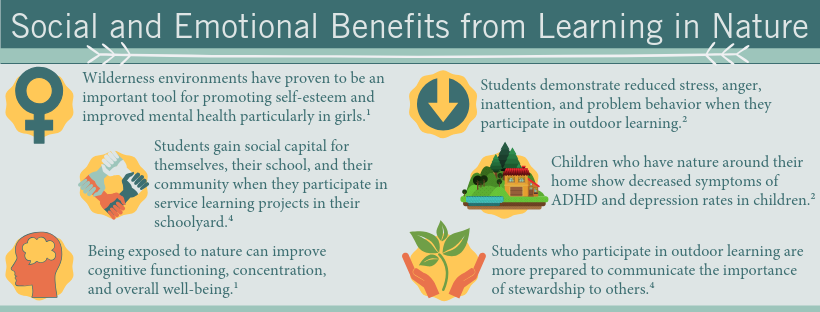
How to Incorporate Social and Emotional Learning into an Outdoor Lesson in Your Own Schoolyard
To provide quality SEL for students, educators should intertwine social and emotional competencies with other subjects throughout the school day, rather than have these techniques as stand-alone lessons. It is important to provide students with a positive student-centered learning environment in the classroom by creating respectful and supportive relationships between student and educator. By incorporating activities, like those listed below into your lessons, you give students time and space to build social and emotional competencies (self-awareness, self-management, social awareness, relationship skills, and responsible decision making)³.
“I want you to know that this program completely changed the way I view and will approach group work. I realized that I’ve always disliked group work because there were always grades and artificial pressure involved that prevented the groups I’ve been a part of from coming together, and truly collaborating. This program has given me a new perspective and approach to connecting with others first, building trust and mutual understanding, before getting down to work. It also taught me to really empathize with others and try hard to understand where they’re coming from.”
– CAC AmeriCorps Member
Supporting Research:
¹Barton, J., Bragg, R., Pretty, J., Roberts, J., & Wood, C. (2016) The Wilderness Expedition: An Effective Life Course Intervention to Improve Young People’s Well-Being and Connectedness to Nature. Journal of Experiential Education, 29(1). 59-72.
²Chawla, L., Keena, K., Pevec, I.,& Stanley, E. (2014). Green Schoolyards as Havens from Stress and Resources for Resilience in Childhood and Adolescence. Health & Place International Journal, 28, 1-13.
³Collaborative for Academic, Social, and Emotional Learning. (2015). Incorporating Social and Personal Competencies into Classroom Instruction and Educator Effectiveness:A Toolkit for Tennessee Teachers and Administrators. Chicago: Author.
⁴Fly, M. J. (n.d.) A Place-based Model for K-12 Education in Tennessee. Retrieved from http://web.utk.edu/~markfly/documents/Place-Based%20K-12%20Education%20Proposal%205_10_10.pdf.
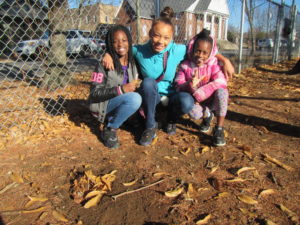
Environmental education can be impactful in just about any outdoor environment, whether you have access to a forest, a wetland, or even just a strip of grass alongside the sidewalk! This means that environmental education can be inexpensive to integrate into curriculum at any grade level. However, additional funding can open up new opportunities for more resource-intensive projects such as butterfly gardens, weather stations, or even residential programs at Tremont Institute. This section notes some basic resources to help educators find and submit funding proposals.
This toolkit provides resources to make the grant seeking process easier.
Our Best Tips for Successfully Getting Money to Fund Outdoor Adventures:
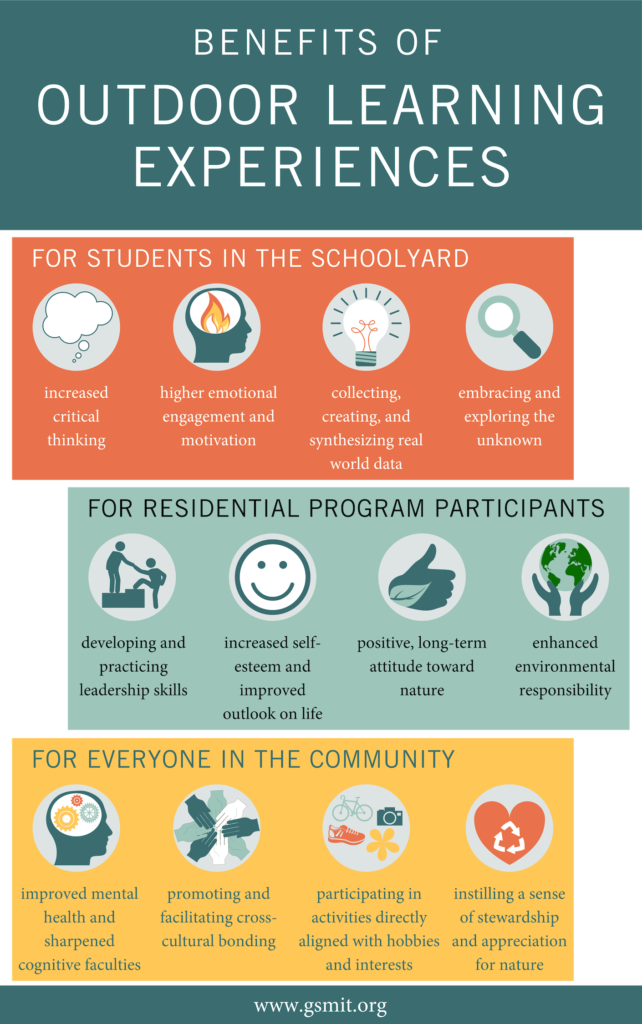
- Focus on the benefits! Benefits of outdoor experiential education can include improvements in critical thinking, 21st century skills, STEM topics, standardized test scores, social and emotional growth, leadership, citizenship, and confidence.
- EE can be an “equalizer” for kids, and ignite a passion for learning that can be fun and rewarding.
- Money spent on EE is cost effective because funding can have a broad and lasting impact.
How can you partner with Tremont Institute on your funding proposal?
- Bring your students to Tremont Institute: Many grantors provide funding to support innovative hands-on education experiences. Consider writing a trip to Tremont into a grant proposal – either to fund your students trip or to provide transportation to the Smokies. ($208/student for a 3-day residential program at co-teaching cost)
- Attend Residential Professional Development at Tremont Institute: Attend one of Tremont Institute’s Educator Professional Development workshops offered throughout the year. Click here to visit the page.
- Schoolyard Professional Development: Reach out to our team at Tremont Institute to learn about our experience with educator trainings in the schoolyard. Trainings with Tremont Institute faculty or our best practices can be included in your grant proposal.
Additional Resources:
Tennessee Environmental Education Association’s list of upcoming grant opportunities
North American Association of Environmental Education’s research reviews and tools
Want to see your schoolyard in a whole new way!? Here are some tips and activities you can use to get to know your schoolyard better.
While studies have shown the benefits of taking your class outside, it can be difficult to plan how to spend class time if you don’t know your schoolyard. Schoolyard mapping is a great way to start. It can be a great resource to identify different ways your school’s outdoor space can become a living laboratory for experiential education. Once your school’s grounds have been surveyed, it’s much easier to know what different land use types are present, where any unique natural or cultural resources are, and even how long it takes to get from your classroom to the exact point you want to visit in your schoolyard.
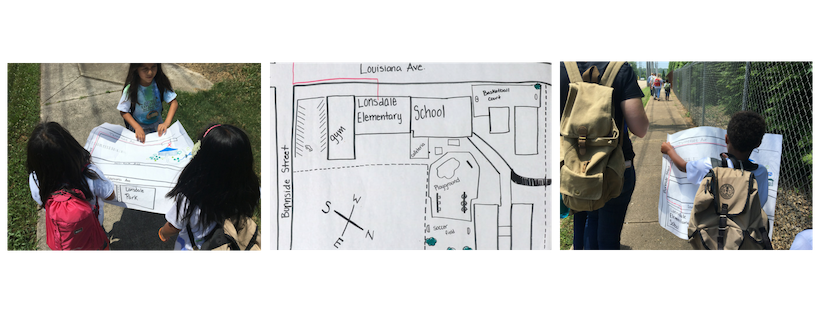
Creating Your Own Schoolyard Map
If you wish you had a community map for your schoolyard, the mapping process itself can be a lesson for your students! Mapping activities can fulfill math, social studies, science, and other standards for all grade levels while getting your students outside for hands-on learning.
Not sure where to start? Check out our Schoolyard Mapping Guide to answer all your mapping questions, including the “why” and “how” of mapping your schoolyard.
What Can Live Here? – A science lesson designed by BEETLES for grades 3-5 to teach about environmental factors
Schoolyard Site Survey Map– An activity for grades K-12 in the 2018 Living Schoolyard Activity Guide by Green Schoolyards America
Helpful Online Mapping Tools
Creating a hand-drawn map is a great way to familiarize yourself and your students with the schoolyard, and using these drawings to create a digital map is an additional step you can take to make this useful resource accessible to more teachers, students, and even community members.
Google MyMaps is a digital mapping platform that works very well for this goal. It’s an interactive application for phones and desktops that allow you to customize Google Maps by adding points, lines, and shapes, as well as photos, videos, and descriptions. These maps can also be shared & collaborated on other Google applications.
Expand Your Horizons
After surveying your schoolyard resources, there are numerous ways you can build on your new resource.
- You may want to add to your map by exploring what exists outside of the school grounds and in the community – other local green spaces such as parks, gardens, or farms could host unique opportunities for discovery and wonder for your students.
- If you’re interested in knowing more about the biodiversity around the school, you could do a BioBlitz to find out what species exist in different parts of the schoolyard.
- You could even make your school grounds more welcoming for local wildlife and get it recognized as a Certified Wildlife Habitat!
Understanding your schoolyard opens up possibilities for enriching outdoor experiences.
Share Your Discoveries With Tremont Institute!
Have you already created a map of your schoolyard? Did you discover something truly unique just outside your classroom? Do you want some more guidance on how to survey the school grounds? We would love to hear from you! Please send your maps, discoveries, and questions toJohn at [email protected].
Resources to Make the Case for Experiential Learning
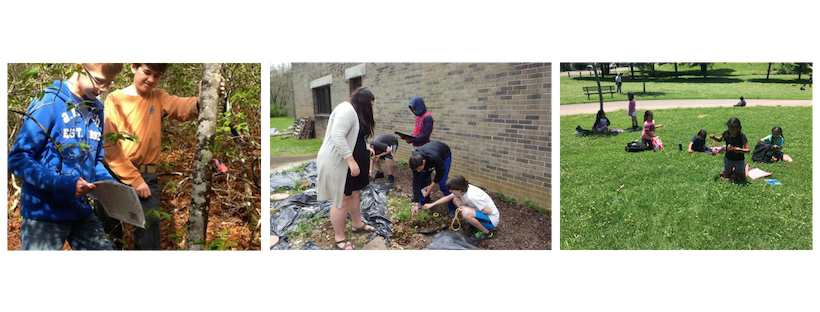
Use this research that has been done on students learning in their schoolyards to better understand how you and your students can benefit from experiential learning. Share these documents with fellow teachers and administration to prove the importance of hands-on learning and how it can be done in your schoolyard, community, and through residential programs.
“8th grade science, 1st period, 25 students. I took my first period outside for 10 minutes once we got all work done in class…What I loved about this was these big 8th graders chose to just run around and play tag. The other kids who were too cool for school started to wiggle around and move too. It was really refreshing to see them act like kids again. There was no fight, no anger, just peace.” – Jen Sauer, South Doyle Middle School