

The How and Why of Weather Monitoring
Written by Lindsey Kessler, Summer Youth Programs Manager
Here in Walker Valley, the tradition of collecting weather data with school students has been ongoing for over 30 years.

If you have ever been a student at Tremont, you have probably seen the Wheel of Weather – a massive wheel used to forecast the weather for the day.
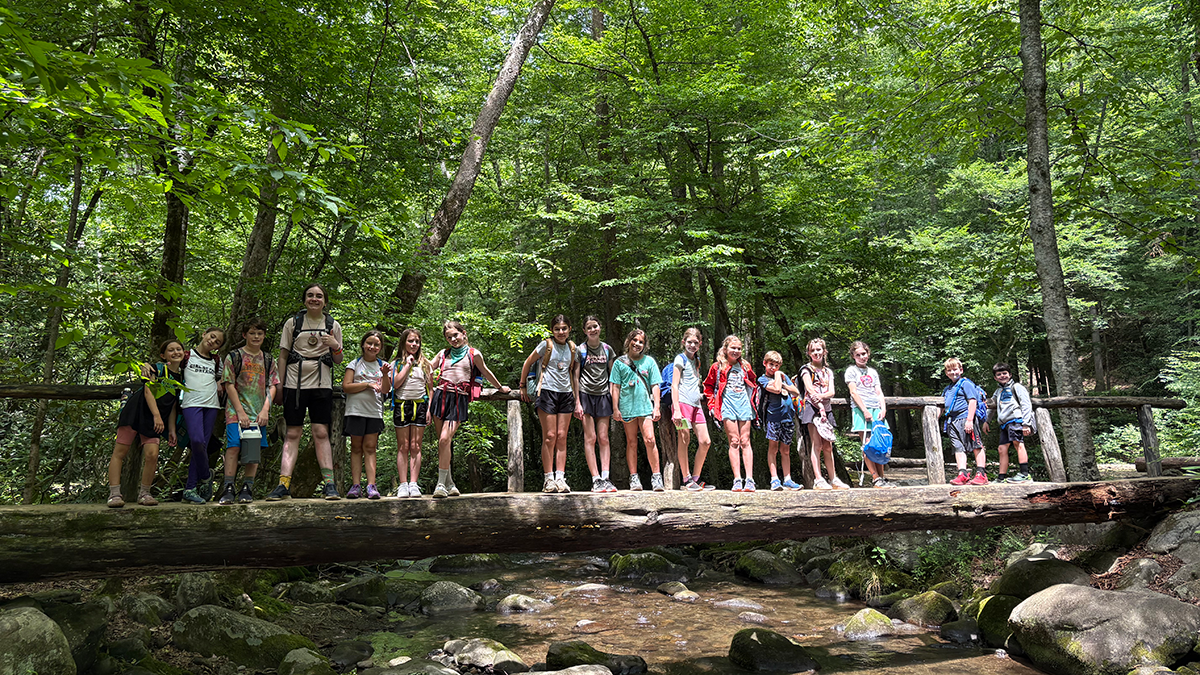
Each morning before breakfast, a small group of students meets at the weather station to collect data on variables such as temperature, barometric pressure, sky/cloud conditions, relative humidity, wind speed, precipitation, and river depth. They then share their findings with the rest of the students during breakfast, and they use the data they collected to predict that day’s weather using our large, impressive Wheel of Weather.
We’ve brought to life, in 3D form, a scientific model called the Sager Weathercaster Algorithm to help us make predictions about the coming weather. Scientific models are used to explain and/or predict the behavior of an object or system; in this case, the system is the behavior of the atmosphere and the resulting weather. The model will give a forecast that predicts the expected precipitation, wind direction, and speed, and sometimes rough indications of temperature. Our model has over 1800 possible combinations of variables, so attention to detail is important! The forecast it creates is for the following 6 hours, so at dinner time we often check back in with the students to see if they think the weather forecast was accurate or not, and we keep track on a visible whiteboard of how many times the predictions have been accurate or not. (So far this year, we’re at 89 days correct and 17 days incorrect).
When children get the chance to collect these data points for themselves, they have the opportunity to understand the factors that make up our weather in a very different way and to handle and work with instruments that meteorologists themselves use in the field.
We’ve been collecting this data since 1991, and share our findings with the National Park Service to help contribute to their long-term weather data collection and research as well. We use this information to see what long-term trends are present in Walker Valley, and talk about what that might mean for our larger environment. We have many community science programs that record and track the seasonal changes in plant, animal, and fungal life here at Tremont, and by collecting parallel data on the weather for over 30 years, we’re able to observe how changes in climate patterns and trends are directly impacting life in Walker Valley.
After experiencing the hands-on nature of our weather monitoring program and the excitement of predicting the weather for each day, many teachers ask us how they can establish a weather station of their own at school. We have resources for helping teachers set up their own weather stations with minimal effort and cost, as well as resources for making your own Wheel of Weather with minimal effort and cost! Check them out here, and don’t hesitate to reach out if you come across any questions!