
Cold-Blooded Resilience: Secrets of a Smokies Winter
This article was written by Erin Rosolina, Marketing Director at Tremont, and was initially published in the Winter 2025-26 issue of Blount County Quarterly. Read it in the original publication.
When most people picture the Smokies in winter, we imagine silent ridges dusted with snow, icy streams, and a forest that seems to sleep. Black bears curl in their dens, migratory birds have flown south, and the frozen ground looks barren and still. Winter, we think, is the season of hibernation – a time when life slows to a whisper.
For much of the Smokies’ charismatic megafauna (the large animals that people tend to notice and love), this is a fairly accurate description. For many of them, winter survival requires migration or hibernation. Most hibernating mammals, such as bats, groundhogs, and chipmunks, can slow their metabolism and lower their body temperature, expending only enough energy to keep their bodies functioning while they slip into deep torpor.
The beloved black bear, though not a true hibernator, withdraws into hollow trees or stumps, lowering its metabolism and sleeping for long stretches. On warmer days, they may wander briefly, and in late January or February, mother bears give birth in their dens.
But even when the trails are quiet and the park’s winter tourism slows, the forest is far from dormant. Beneath the bark and under the leaf litter, life hums on. Winter might be the off-season for people, but for many amphibians, it’s an integral part of the cycle.
Those Who Don’t Sleep

Southern two-lined salamander. Photo by Jay Zimmer.
The Smokies are often called the “Salamander Capital of the World.” With more than 30 species living in the national park, these mountains are among the most biodiverse amphibian habitats on Earth. Their abundance owes much to the region’s geology, elevation range, constant moisture, and the patchwork of cool, shaded microhabitats such as seeps, springs, and mossy ravines.
Many of the Smokies’ salamanders belong to the Plethodontid family – lungless salamanders that use cutaneous respiration to breathe through their skin. This remarkable adaptation ties them to moisture; their lives depend on damp soil and leaf litter. Unlike mammals and birds, salamanders don’t generate or regulate internal body heat and, as cold-blooded ectotherms, their body temperature mirrors the world around them. To survive winter, they simply avoid freezing.
Rather than true hibernation, many amphibians enter a flexible state called brumation – a slowdown rather than a shutdown. Metabolism drops, movement slows, but they can still rouse to feed or shift locations when conditions allow. On mild, wet winter days, it’s not uncommon to find salamanders active near seeps and stream edges, even when ice rims the rocks. Plethodontids can remain active at surprisingly low temperatures as long as the air and soil stay moist and ice doesn’t form inside their body tissues.
This quiet persistence defies the notion that winter in the woods means sleep.
Natural Antifreeze
Among the amphibians of the Smokies, one species stands out for a feat almost beyond belief: the wood frog (Lithobates sylvaticus). Unlike salamanders, which must avoid freezing, wood frogs can survive it. They can do something that salamanders absolutely cannot: survive being frozen solid.

Wood frog photo by Jeanette Kazmierczak.
Ranging as far north as the Arctic Circle, these small brown frogs endure temperatures that plunge well below zero. When ice touches their skin, their liver releases massive amounts of glucose into the bloodstream – more than a hundred times the usual level – creating a sugary antifreeze inside their cells. The cells themselves dehydrate slightly, allowing ice to form between them rather than within (which would be lethal to most animals). The frog’s heart stops beating. Its lungs cease to move. Its brain activity flatlines. Up to seventy percent of its body water can turn to ice.
And yet, when spring warmth returns, the frog thaws, takes a breath, and hops away as though nothing happened. It’s one of the only vertebrates on Earth that can freeze solid and live – a tiny superhero of adaptation.
Winter Nurseries
Some salamanders don’t just survive winter, but begin their most important work in it.
As late-winter rains and snowmelt fill forest depressions, vernal pools appear. These are shallow, ephemeral ponds that last only a few months; because they dry up by summer, they never harbor fish, making them safe havens for amphibian eggs and larvae.
At Tremont, we run the only continuous long-term amphibian monitoring project in Great Smoky Mountains National Park. From January through April, volunteers and staff wade into cold, dark, ephemeral pools to count egg masses of wood frogs and spotted salamanders (Ambystoma maculatum). We record the quantity and quality of egg masses, as well as water chemistry and temperature, contributing data that helps park scientists understand long-term population trends.

Wood frog eggs counted by Tremont volunteers. Photo by Erin Rosolina.
As long as the water doesn’t freeze solid, the eggs can survive. Their jelly-like coating insulates them from the cold, and forested vernal pools in the Smokies rarely freeze through. Breeding in winter offers unexpected advantages: fewer aquatic insect predators, no fish in these temporary ponds, and less competition from other amphibians. Larvae hatch early, feeding and growing before the pools dry, giving them a head start by summer metamorphosis; this head start is crucial for their species’ survival.
It’s a whisper of spring, hidden in still, cold water.
Why We Should Watch

Pygmy salamander. Photo by John Maerz.
Amphibians are more than quiet forest inhabitants. They occupy a vital ecological niche as both predator and prey. Over their lifetimes, salamanders and frogs consume vast numbers of insects and invertebrates, helping to regulate populations. In turn, they sustain raccoons, birds, and other forest animals.
By studying amphibian populations, Tremont’s community science program provides early insight into the health of the park’s ecosystems. Changes in water cycles, disease, climate patterns, or habitat disturbance often show up first in these sensitive species. Long-term monitoring helps researchers and park managers identify trends and act before problems grow.
But beyond science lies something simpler and deeper: wonder. There’s magic in kneeling beside a February vernal pool, seeing silent eggs glimmering beneath frigid water. There’s awe in lifting a damp log and finding a salamander alive and well despite the winter chill. These encounters remind us that the Smokies’ vitality doesn’t vanish with the leaves – it just may be buried under them.
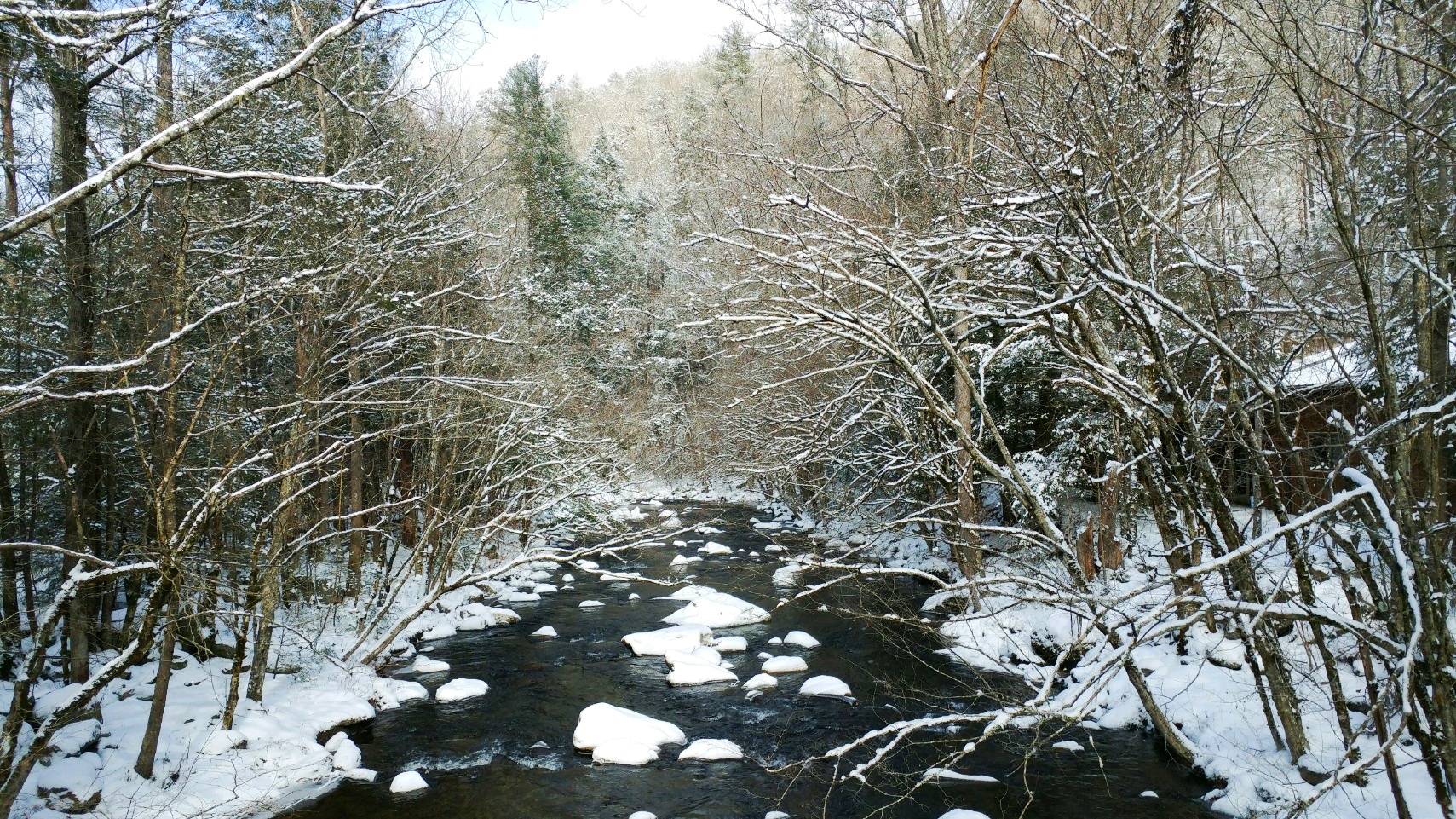
Cover image: Snow on the Middle Prong. Photo by Emily Stein.