
Lessons from a Butterfly
Written by Hannah Hembree, Summer Community Science Educator
I think one of the biggest events that impacted my summer was a butterfly. As cliche as it might sound to discuss the impact that a single butterfly’s wingbeat has upon the world, actually seeing it and feeling the impact of that flutter brings an understanding to the phrase “butterfly effect.” Perhaps here, recording this summer highlight, you will feel the reverberations of its delicate wings yourself.
This all started early one morning during a bird banding session. I was returning to the banding station when the movement of vibrant coloration caught my eye. The butterfly’s flight into my life was far from the elegant dance you might have expected; rather, Midnight (as he would later be called) was struggling to fly, seemingly unable to get higher than a foot off the ground. Although, at the time, I knew relatively little about butterflies, I had a hunch he was likely facing the conclusion of his lifespan. Not wanting him to be crushed underfoot or hit by the cars in the nearby parking lot, I gently scooped him up in the palm of my hand and carried him toward the bird banding station.
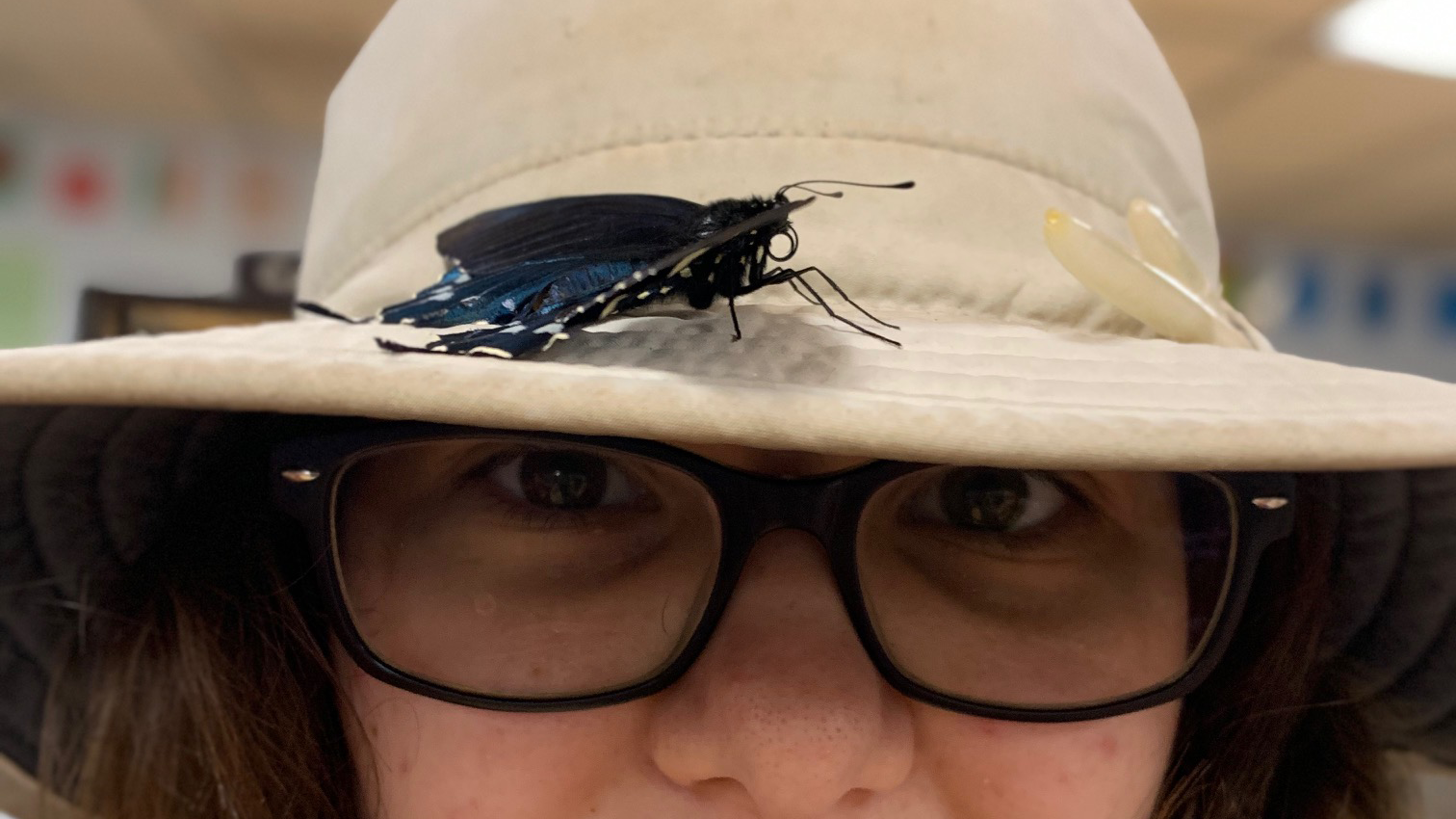
Once there, his presence was met with praises of his beauty and his species was identified by a volunteer. Midnight was a Pipevine Swallowtail recognizable by the single row of orange spots on the outer portion of his lower wings. I set him down gently by my belongings while I checked mist nets and recorded information on birds we caught, and whether unable or unwilling, he stayed patiently where I had set him. Eventually, it was time to pack up. I think it was then that I decided I’d loyally stick with him until the end. It sounds dramatic, but I was fascinated and more than a little invested in my new friend.
It was needing to use both my hands to enter the building that had us both discovering his new home. After all, I needed somewhere stable to set him that wouldn’t damage his delicate wings. The answer: my hat! I lifted him up and as if he approved, he crawled right on the front near where the decorative feathers were attached. The material gave him a good grip and the wide brim allowed Midnight plenty of room to stretch his wings. I like to think he appreciated the height as well – perhaps he couldn’t fly anymore, but maybe a free ride wasn’t so bad.
Regardless, entering the dining hall, I had never felt so many eyes on my hat! Midnight was instantly popular with the campers, many coming up to see him and a few in disbelief that a live butterfly was just hanging out on my hat. The joy and wonder I witnessed him bring was indescribable as I gently guided him to perch on the hands of the kids.
The campers were wrapped up in the magical moment – even those who had been scared or nervous had their doubts conquered as the ticklish legs gently moved about. I have no doubt he made a long-lasting memory for them.
That evening, with Midnight perched next to some sugar water, I did some research. I knew him, my friend perched on my hat, but I wanted to know more. (Oh, how amazing that this experience I was having is exactly what we want to give to everyone who comes to Tremont.) I discovered a lot, including that Pipevine swallowtails are poisonous; most things, anoles aside, won’t eat them. Additionally, they are sexually dimorphic, meaning that the males look different from the females. In Midnight’s case, bright iridescent blue on both sides of the wings revealed his masculine glamor.
I also learned a bit more about Midnight’s life. He hatched from a bright red egg, grew up eating birthworts, and spent somewhere between 10-20 days in a chrysalis before emerging with those beautiful, blue iridescent wings that so many other butterflies imitate to avoid being eaten. But Midnight’s life could not last forever. Adult Pipevine Swallowtails only live about 6-14 days. In the end, I spent about two days with my friend, before he left for the big meadow in the sky. He taught me so much in that time, and he inspired so many others’ connections with nature.
A single butterfly – not even an uncommon or rare species – has made this impact on me and on others. Even now, still in death, Midnight is beautiful. The impact he made gave life to ideas of positive impacts I can bring to others as I continue to educate people about the natural world. So I invite you to let Midnight the Pipevine Swallowtail ripple an impact in your life, or find your very own butterfly, actual or metaphorical, to give that gentle wingbeat of change to your day-to-day.